a) Artificial Intelligence for Grade 1 to Grade 12
a) Artificial Intelligence for Grade 1 to Grade 12
Discover AI. Think Creatively. Build the Futures
Program Overview
The Artificial Intelligence Explorers curriculum is a progressive, age-appropriate AI education program designed for students from Grade 1 to Grade 12.
The program introduces Artificial Intelligence not as a difficult technical subject, but as a way of observing, questioning, reasoning, creating, experimenting, and solving problems.
As students progress through the grades, they move from playful exploration and basic computational thinking to Data Science, Machine Learning, Computer Vision, Generative AI, Robotics, Scientific AI, Responsible AI, Research, Innovation, and advanced domain-oriented AI applications.
The curriculum builds a strong foundation for future studies in Artificial Intelligence, Machine Learning, Data Science, Computer Science, and Computational Thinking, while developing skills that extend far beyond technology.
Program Philosophy
This curriculum follows a progressive learning philosophy that combines school education, computational thinking, AI, creativity, and real-world problem solving.
Students gradually move through the learning journey:
Explore → Understand → Experiment → Create → Analyze → Build → Innovate
Each grade introduces new concepts and increases the level of complexity according to the student’s academic and cognitive development.
Learning begins with curiosity and discovery and progressively develops into programming, data analysis, AI applications, research, innovation, and independent project development.
Why This Program Stands Out
Age-Appropriate AI Education
The curriculum is specifically designed for school learners, with the depth and complexity increasing naturally from Grade 1 through Grade 12.
Younger learners explore AI through:
- Stories and visual demonstrations
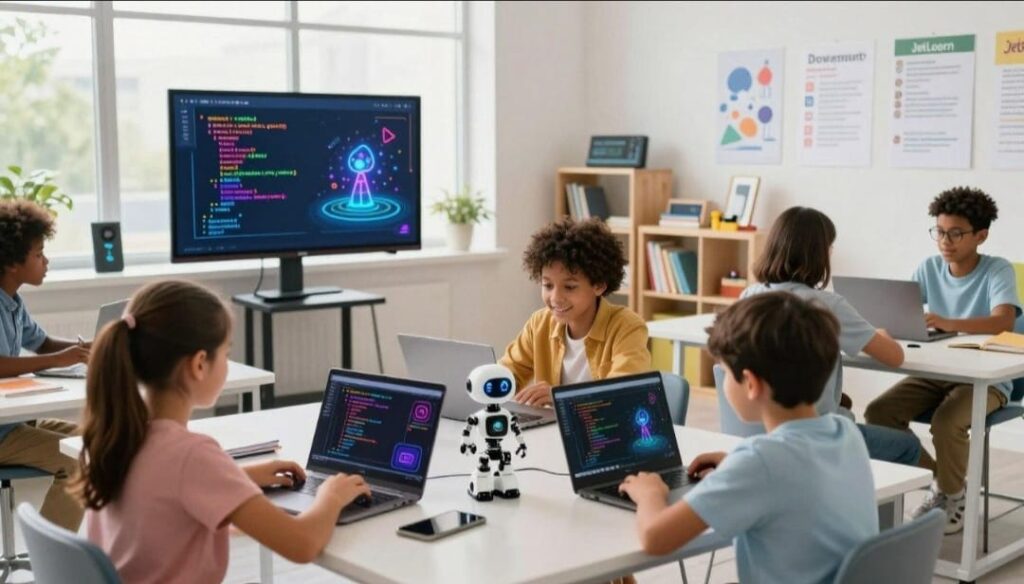
- Games and classroom missions
- Observation and discovery
- Simple data activities
- Hands-on experiments
- Visual programming
- Creative projects
As students advance, they progressively explore computational thinking, programming, Data Science, Machine Learning, Computer Vision, Robotics, Generative AI, Scientific AI, and advanced applications.
NCERT-Integrated Learning
Artificial Intelligence is connected with subjects students already study in school, including:
- Mathematics
- Science
- Environmental Studies
- Social Science
- Geography
- History
- Civics
- Economics
- Language
- Computer Science
This approach helps students understand AI through familiar academic concepts and real-world situations.
70% Practical | 30% Theory
The program follows a 70% Practical and 30% Theory learning approach.
Students learn by doing through:
- Interactive activities
- Games and challenges
- Investigations
- Experiments
- Surveys
- Data collection
- Simulations
- Visual programming
- AI demonstrations
- Collaborative activities
- Projects
- Presentations
What Students Will Learn
Artificial Intelligence Foundations
Students discover what Artificial Intelligence is, how intelligent systems work, and where AI appears in everyday life.
They explore how machines can observe, recognize patterns, process information, make predictions, and assist people in solving problems.
Computational Thinking & Algorithms
Students learn to break complex problems into smaller parts, recognize patterns, identify important information, and design step-by-step solutions using:
- Algorithms
- Flowcharts
- Pseudocode
- Computational thinking
- Problem-solving techniques
Programming & Digital Problem Solving
Students progress from visual programming and simple computational activities toward Python programming, data handling, coding projects, and AI applications.
Data Science & Data Literacy
Students progressively learn:
- Data collection
- Data organization
- Datasets
- Data cleaning
- Data analysis
- Data visualization
- Dashboards
- Prediction
- Data storytelling
Machine Learning
Students discover how machines learn from examples and patterns.
Through progressively deeper activities and projects, they explore:
- Classification
- Prediction
- Feature recognition
- Model training
- Intelligent decision-making
Computer Vision
Students explore how AI can interpret images and visual information through:
- Image recognition
- Object recognition
- Pattern recognition
- Object detection
- Image classification
- Feature detection
- Motion tracking
- Facial recognition
- Medical imaging
- 3D and spatial intelligence
Robotics, Sensors & Intelligent Systems
Students learn how intelligent machines interact with the physical world through:
- Sensors
- Smart devices
- Robotics
- Autonomous navigation
- Motion analytics
- Internet of Things
- Smart systems
- Intelligent machines
- Industrial AI
Generative AI & Intelligent Assistants
Senior-grade students are introduced to modern Generative AI concepts including:
- Large Language Models
- AI assistants
- Prompt engineering
- AI-powered research
- Knowledge extraction
- Summarization
- Creative AI
- AI agents
Students also learn about AI limitations, hallucinations, bias, privacy, and responsible AI use.
Real-World AI Applications
Students explore Artificial Intelligence across multiple real-world domains, including:
- Healthcare
- Agriculture
- Climate and environmental monitoring
- Wildlife conservation
- Space exploration
- Satellite imaging
- Smart cities
- Transportation
- Navigation
- Scientific research
- Cultural heritage
- Governance
- Business intelligence
- Social development
This helps students understand that AI extends beyond chatbots and technology companies and can be applied to meaningful challenges across society.
AI Across School Subjects
The curriculum connects AI with different academic disciplines.
Mathematics → Prediction, Statistics, Patterns & Optimization
Science → Scientific AI, Healthcare, Robotics & Intelligent Systems
Geography → GIS, Navigation, Satellite Intelligence & Earth Observation
Environmental Studies → Climate AI, Sustainability & Resource Management
History → Digital Heritage, Knowledge Systems & Cultural Intelligence
Social Science → Governance, Decision Systems & Responsible AI
Language → NLP, Communication & Generative AI
Art & Creativity → Generative AI, Digital Media & Creative Intelligence
Gamified Learning
Learning is structured around interactive missions and challenges.
Students become:
- AI Explorers
- Pattern Detectives
- Data Scientists
- Machine Learning Explorers
- Digital Problem Solvers
- System Thinkers
- Creative Technologists
- Ethical Decision Makers
These activities make complex concepts approachable while developing curiosity, computational thinking, and problem-solving skills.
Hands-On Technology Exposure
Students progressively interact with age-appropriate technologies and platforms such as:
Scratch • ScratchJr • Google Teachable Machine • Google Lens • Google Sheets • Microsoft Excel • Google Colab • Python • Orange Data Mining • GeoGebra • Google Earth • Google Maps • Canva • Tinkercad • MIT App Inventor • ChatGPT • Gemini • NotebookLM • Perplexity
As students advance, technology exposure becomes progressively more sophisticated, supporting deeper experimentation, programming, AI development, and project work.
Real-World Projects
Students learn by creating tangible outcomes rather than simply studying concepts.
Projects may include:
- AI observation journals
- Datasets and data reports
- Prediction systems
- Classification projects
- Data dashboards
- Smart navigation systems
- Environmental monitoring projects
- Smart agriculture systems
- Healthcare AI projects
- Robotics projects
- Computer vision applications
- Generative AI applications
- Smart city solutions
- AI assistants
- Sustainability projects
Projects become increasingly independent and interdisciplinary as students progress through higher grades.
AI for Good
The curriculum connects AI with meaningful human and societal challenges.
Students explore AI applications in:
- Environmental conservation
- Sustainable agriculture
- Healthcare
- Disaster preparedness
- Wildlife protection
- Smart communities
- Education
- Public services
- Cultural preservation
- Climate intelligence
Higher-grade students participate in interdisciplinary AI for Good challenges while considering fairness, privacy, sustainability, and ethical decision-making.
Responsible AI & Digital Citizenship
Responsible technology use is embedded throughout the curriculum.
Students progressively learn about:
- Privacy
- Digital safety
- Fairness
- Bias
- Transparency
- Responsible data use
- Misinformation
- Deepfakes
- Ethical AI
- Human judgment
- Responsible technology use
- Digital citizenship
The goal is to help students understand not only how to build with AI, but also when, why, and how AI should be used responsibly.
Research & Innovation Exposure
As students progress into higher grades, they receive exposure to real-world AI ecosystems through:
- Industry case studies
- AI webinars
- Research activities
- Kaggle and domain challenges
- Mini hackathons
- AI innovation showcases
- Prototype development
- Industry-oriented projects
Students build an evolving portfolio containing project documentation, presentations, research work, reflection journals, and project showcases.
Specialized AI Pathways
Senior-grade students can explore AI according to their academic interests and future career aspirations.
Engineering & Computer Science
Explore:
- Machine Learning
- Computer Vision
- Deep Learning awareness
- AI development
- Intelligent automation
- Robotics
- AI deployment
Healthcare & Life Sciences
Explore:
- Healthcare analytics
- Disease prediction
- Medical imaging
- Clinical decision support
- Wearable technologies
- Bioinformatics
- Healthcare AI
Business & Data Intelligence
Explore:
- Business analytics
- Recommendation systems
- Demand forecasting
- Financial analytics
- Customer intelligence
- Supply chain optimization
- Intelligent decision systems
Humanities, Arts & Society
Explore:
- AI governance
- Public policy
- NLP
- Digital heritage
- Journalism
- Cultural intelligence
- Creative AI
- Media analytics
- Human-AI interaction
Portfolio-Based Learning
Every stage of the program contributes to a student’s growing AI portfolio.
Depending on their grade level, students may build:
- Activity portfolios
- AI journals
- Data projects
- Coding projects
- Dashboards
- Research work
- Project reports
- Presentations
- Prototypes
- Hackathon work
- Capstone projects
The portfolio becomes a visible record of the student’s progression from curious learner to independent AI problem solver.
Capstone Experience
The curriculum culminates in interdisciplinary AI innovation and capstone experiences.
Students identify meaningful problems, collect and analyze information, design AI-based solutions, develop working prototypes, test and improve their ideas, and present their outcomes.
Capstone themes may include:
- Smart Education
- Smart Healthcare
- Smart Agriculture
- Environmental Intelligence
- Climate & Disaster Management
- Smart Cities
- Wildlife Conservation
- Intelligent Transportation
- Social Innovation
- AI for Governance
- Creative AI
- AI Research & Product Innovation
The emphasis is not simply on creating a technically impressive project, but on demonstrating how AI can be thoughtfully applied to address a real-world problem.
What Students Will Be Able to Do
By the end of the full learning journey, students will be able to:
- Understand the fundamental concepts of Artificial Intelligence.
- Think computationally and approach problems systematically.
- Collect, organize, analyze, and visualize data.
- Recognize patterns and develop predictive thinking.
- Understand how Machine Learning systems learn from examples.
- Build age-appropriate AI and technology projects.
- Develop programming skills progressively.
- Work with visual, numerical, textual, geographical, and scientific data.
- Explore Computer Vision and intelligent systems.
- Understand robotics, sensors, IoT, and autonomous systems.
- Use Generative AI tools responsibly and creatively.
- Apply AI to science, healthcare, agriculture, environment, business, society, and creative fields.
- Develop research, communication, collaboration, and presentation skills.
- Identify real-world problems that can be addressed using AI.
- Design and present AI-powered solutions.
- Understand fairness, privacy, transparency, and responsible AI.
- Build a portfolio demonstrating their growth in AI and computational thinking.
Assessment & Student Growth
Student learning is evaluated through:
- Portfolio Development
- Activity Participation
- Projects
- Presentations
Assessment evolves according to the student’s grade level and focuses not only on what students know, but also on how they explore, create, communicate, collaborate, and solve problems.
The Learning Philosophy
We believe children should not be taught simply to use Artificial Intelligence.
They should be taught to understand it, question it, create with it, and use it responsibly.
That is why the curriculum begins with curiosity and gradually develops computational thinking, data literacy, programming, Machine Learning, creativity, research, innovation, and real-world problem solving.
Every grade adds another layer.
Every project becomes a little more ambitious.
Every year, the student moves from exploring technology to creating with technology.
The goal is not to produce children who merely know AI terminology.
The goal is to nurture a generation of curious thinkers, creative builders, responsible digital citizens, and future AI innovators.
Outcome-Driven Curriculum
Learn skills that matter through age-appropriate and organization-specific curricula, with hands-on exposure across every aspect of AI designed to help learners advance beyond conventional education and corporate training.
Hybrid Learning & Industry Mentorship
5 Days Recorded + 2 Days Live with Industry Mentors — learn through structured recorded sessions led by industry-exposed academicians, complemented by live sessions with industry mentors for practical guidance and deeper learning.
Learners who Build lead to Transformation
Making AI education practical, future-ready, and impact-driven by empowering learners to turn knowledge into skills, skills into solutions, and solutions into meaningful impact.